Counting on Clicks <<<< Adding more Repeat Visitors to the community.
Learn how to forge enduring relationships in the digital realm with effective strategies. Explore techniques to build lasting connections in digital marketing and establish a strong online presence. Discover the keys to fostering engagement, trust, and loyalty with your audience.
It’s essential to recognize that successful marketing extends far beyond merely counting clicks – it’s about fostering a community of loyal repeat visitors who engage with your brand on a deeper level.
Here’s why prioritizing repeat visitors matters and how we, at Intelo Media achieve it
✅ Relationship building –
Establishing trust and rapport with your audience is paramount.
We focus on building genuine connections through personalized interactions, empathetic communication, and consistent engagement across multiple channels.
✅ Value-driven content –
We create content that provides real value to your audience.
Whether it’s educational resources, entertaining stories, or practical solutions, offering content that meets your audience’s needs and interests encourages them to return for more.
✅Consistent engagement –
Stay top-of-mind by maintaining regular communication with your audience.
We utilize email marketing, social media, and other channels to nurture ongoing conversations and interactions.
✅ Customer-centric approach –
We tailor your marketing strategies to prioritize the needs and preferences of your audience.
By understanding their pain points, desires, and behaviors, we can deliver personalized experiences that resonate and encourage repeat visits.
By shifting your focus from clicks to building lasting relationships, you’ll not only drive repeat business but also cultivate brand advocates who actively promote your brand to others.
Let’s connect for a value-added approach of marketing!
Digital marketing is now a must-have for any product or service. With the growing usage of the internet, modern marketing has opened up a plethora of options. Digital marketing for real estate has proven to be a game-changer, helping the industry thrive by reaching a broader audience. As per recent data, over 92 percent of customers conduct research on a product before making a purchase decision. The purpose of having a strong online presence for a firm is to help the brand identity stand out.
With time, marketing methods improve and change. Users of digital space are aware that it has a number of advantages. Real estate digital marketing now has a reach that extends beyond urban areas and is gaining traction in tier 2 and 3 cities. Many of these advantages have yet to be exploited by real estate developers, who are still trapped on the ground.
What is Digital Marketing for Real Estate?
Land plus improvements, such as buildings, furnishings, roads, structures, as well as utility systems, make up real estate. Property rights confer ownership of land, infrastructure, and environmental assets such as minerals, vegetation, animals, or water, among other things. So, as a realtor, how would you differentiate yourself from the competition? Developing a digital marketing plan is the new normal in many sectors. To stay ahead of your competition, you must begin to take digital marketing seriously, since it is critical for increasing brand awareness, increasing visibility, and drawing more customers to your firm as a real estate agent. Several realtors as well as brokers today underestimate the importance of Digital marketing in the real estate industry. Digital marketing not only raises brand recognition but also helps firms stand out among those who are competing.
Your Real Estate Company will skyrocket with our Digital Marketing Services!
Everyone nowadays (more so than ever) uses a search engine to find almost any bit of information. No one wastes time asking other people or next-door neighbours for facts when a cell phone or computer can provide the information in a matter of minutes. As a result, you’ll want to build a presence online to increase brand awareness. That is, here’s where potential leads congregate, and you don’t want to lose out on people discovering you as a result of their searches.
Several studies have shown that mobile advertising campaigns are more successful than other online standard practices. It’s easy to see why so many people use cell phones to access their websites. In addition, videos boost conversion rates. Watching a product presentation video may help a potential customer make a purchase choice and convert the audience into leads. The real estate industry is undeniably saturated. What can you do to make yourself stand out from the rest?
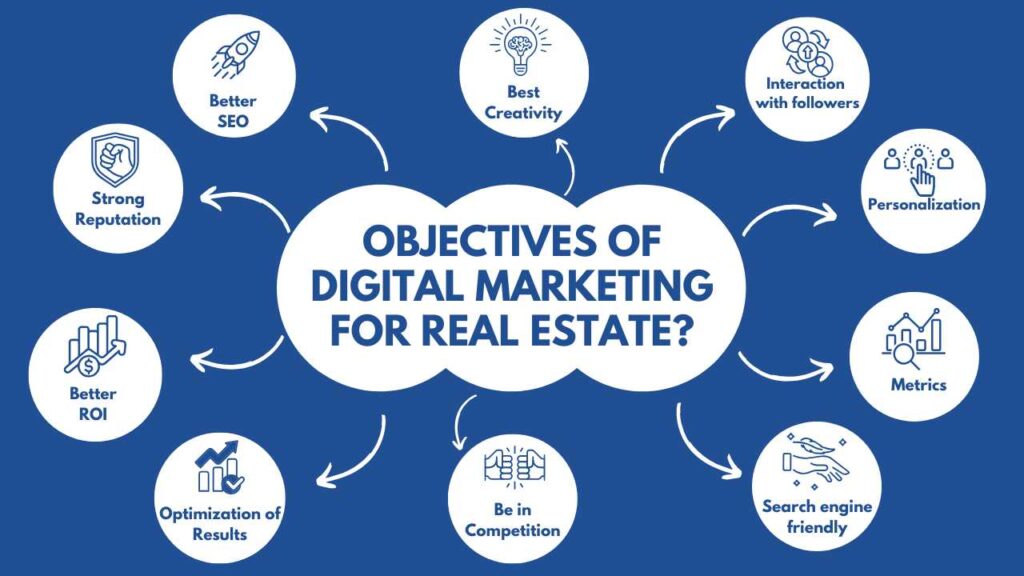
Objectives of Digital Marketing for Real Estate?
You can’t overlook the importance of digital marketing, especially if you’re in the real estate industry. Before examining houses, many potential house buyers use the Internet to research extensively.
Better SEO –
SEO is a method for increasing website traffic by guaranteeing that the website can be discovered quickly in search engines. Property professionals want to increase their website’s rating and get it near the top of Google’s list. As a result, a well-thought-out SEO campaign may bring the correct people to your property.
Strong Reputation –
The purchasing and selling of properties is based on a phrase. A very well new networking, e-mail, and digital marketing strategy may help real estate brands and agents stand out from the crowd. The better evaluations a realtor receives, the more likely they are to see an increase in business.
Better ROI –
Assign the appropriate money to the appropriate marketing sectors in order to maximize your return on investment. This is where a plan may come in handy, ensuring that everything is in sync and that your campaigns are on the same page. There will be less time and money spent.
Optimization of Results –
Have you scheduled time to go through your findings and take action? You should add it if you haven’t already. A digital marketing plan allows you to continuously enhance critical parts of your digital marketing while also allowing you to understand where your efforts are yielding benefits.
Be in Competition –
Competitor intelligence is necessary for determining your company’s position in your sector. Setting up Google Alerts, on the other hand, allows you to keep track of this fast and efficiently. It’s a simple way to learn about your competitors’ newest news, as well as their current product and marketing initiatives.
Search engine friendly –
When you need knowledge about property pricing, how inclined are you to call a friend? It’s possible, but not always. Some argue that why go through the difficulty when knowledge can be accessed with just a few mouse clicks? Most individuals in the digital era rely heavily on search results for news and information.
Metrics –
It’s easy to determine the effectiveness of your online marketing strategy when you use web analytics and other online measurement tools. You can get extensive information on how customers interact with your webpage or react to your marketing by using Google Analytics.
Personalization –
Consider this: if your client database is integrated into your website, you may greet visitors with targeted offers anytime they arrive. The more properties they book with you, the more you can develop your client profile and promote to them efficiently.
Interaction with followers –
Home buyers are phoning real estate brokers with queries about a house considerably less than they used to. They’re looking online and posting at real estate agents on Twitter, utilizing Facebook’s Recommendations tool. This outreach encourages followers to become more interested in the product throughout the early stages of the purchasing process.
Best Creativity –
Users are encouraged to think outside the box in the digital environment, and you may utilize a range of digital functionalities to interact with your audience. You might, for example, use Instagram Stories’ Question Me Anything feature to collect feedback from your clients about problems they’re having!
Services we Offer
Here are a few of the services we offer for Digital Marketing for Real Estate –
Search Engine Optimization –
Is your website user-friendly, allowing visitors to quickly locate what they’re searching for, browse through many results, evaluate listings, and purchase from you? If not, search engine optimization (SEO) is what you’re looking for. SEO for real estate simply means showing up in search results when customers are seeking someone to assist them purchase or sell a home. Search engine optimization (SEO) allows you to improve your website for search engines, increasing its visibility in search results and resulting in more eyes (plus offers) on your existing resources.
Is your website responsive, safe, and mobile-friendly? Do you really have a tried-and-true email funnel as well as a follow-up mechanism in place to help prospects interact with you? SEO is, without a doubt, the most critical factor for every realtor to think about. SEO can push your digital identity to another level, from technical Searches to keywords, website inspections, as well as other technicalities.
Social Media Marketing –
Realtors use social media to advertise and display their businesses and properties, which is known as real estate digital marketing. Social media marketing is a very important aspect of all business’s marketing strategies, and the real estate industry is no different. According to research by Realtors, 77 percent of realtors make use of social media to promote real estate in some capacity. As a result, the presence of real estate brands online is a foregone conclusion. To engage and communicate with customers as well as prospects, realtors use social media platforms like Facebook, LinkedIn, etc. The way to interact, connect, and advertise to their intended audience personalised geography, and behaviour makes social media a perfect platform for realtors. You may publish information such as articles, photographs, and videos, as well as send messages, reply to comments, and advertise to targeted audiences when you pick a social network.
Google Ads –
Are you considering a large advertising expense to reach potential customers? You should think about putting it to good use. Advertisers may save time by using Google search advertisements, and consumers can get the best advertising for their search query. A strong pay-per-click (PPC) strategy requires targeted text adverts. Most of the big search engines function similarly when it comes to Google search advertisements. These really are text-based advertisements that appear on Google’s SERPs.
Content Marketing –
Strategic planning is required for effective content marketing. Real estate agents must consider what they will say, as well as how and where they will say it. This entails understanding your buyer persona and the routes through which they might be addressed. Content is an excellent strategy for attracting new customers and increasing brand recognition. Social networking and blogging are two excellent places to begin. When you put time and resources into content marketing, you’re looking to entice leads, acquire and retain prospects, and gain new customers.
The goal of content marketing in real estate is to sell experiences rather than properties. Content marketing is an effective way to raise brand recognition and generate leads. As a qualified real estate agent, developing a social media presence may assist increase referrals and help prospective clients think of you.
Blogs, social networking, and SEO are all tried and true methods for attracting and converting readers into buyers. The decision to establish is content marketing. Content marketing for real estate is a big and complicated minefield. It serves as the foundation for your internet marketing operations, allowing you to acquire more visibility and raise brand awareness. Content marketing is necessary if you want to become an expert in the real estate sector.
Video Marketing –
Real estate form of video marketing is one of the most effective strategies to produce more revenue and higher-quality real estate leads. This is because, on a deeper look, potential purchasers are simpler to persuade and convert. They have fewer uncertainties and inquiries when they experience the property through visual materials. Video is a persuasive “key” to their home acquisition. People will remember what they can see, and real estate, for the most part, is based on aesthetic attractiveness.
Every marketer’s tool belt should include video, and if you’re in real estate, you’re obviously a marketer. Real estate is all about trust and perception, and a personal video may make you appear more pleasant, which may boost your consumer loyalty in you. If you’d like to reach out to these people, you must utilize video. Video is being favoured by digital algorithms, such as social networks like Facebook or Instagram as well as search engines like Google, in addition to becoming the most engaged sort of material online. That implies that if you aren’t utilizing videos to reach out to your customers on these platforms, your competitors are.
Reputation Management –
If unfavorable word of mouth spreads about your firm, you know you’re in big danger. Brand reputation is extremely important in the real estate industry. Maintaining a great internet reputation will help you gain more clients. People are using the Internet to locate real estate agents and properties. It is critical to use ORM tactics to boost your real estate agency’s exposure.
Website Designing –
If you’re a realtor or builder who relies on referrals and other outdated techniques, now is the time to invest in a website design for your company. A user-friendly and artistically produced real estate website design may instill trust in users, encouraging them to select your business for their real estate requirements. If a business real estate company doesn’t have an internet presence, you’re missing out on a lot of money. In reality, there is no reason why your real estate company should not have an internet presence. As a business owner, if you want to start digital marketing for real estate company then you must have your website. Here are some of the reasons why almost every real estate company should create a website.
Why Should you choose us?
Because we are the pioneers of Digital Marketing for Real Estate companies!
We are on time and pay attention! – We have a history of exceeding our client’s standards and meeting their requirements. For both of our programs, we never run out of funds. In terms of cost, our programs will speak for themselves.
Completely honest with our clients – We believe in being completely frank with our clients. We go into every detail of the services.
We offer research reports – Before reaching any conclusions, our team of experts locates the analysis reports.
What else do you get?
A skilled manager – If you have any issues or complaints, you should still contact your designated manager.
Team of experts – Our experts are well-trained and have several years of experience in this area.
High-Quality Work – We always ensure that our work is of the highest quality.
Frequently Asked Questions (FAQs) –
Q-1: Why should your Real Estate seek digital marketing?
Ans – In today’s changing market, developing or selling real estate and assets needs a focused concentration. To help your firm expand, you want to establish a clear, lucrative real estate marketing plan. These eight techniques to increase sales that we just mentioned can give your company or yourself a huge advantage!
Q-2: How can you optimize your website for Real Estate?
Ans – You must ensure that your website is eye-catching and intriguing enough to captivate and hold the visitor’s attention. Emphasize your abilities and include facts that will pique the attention of your audience. Consider the perspective of the buyer and how you may bring value to their real estate needs.
Q-3: Why do you need attractive content for Real Estate?
Ans – You can’t disregard the value of delivering fresh, dynamic, and frequent content to your webpage if you want to attract visitors. Blog articles, videos, fact sheets, case studies, and e-books are just a few examples.
Q-4: Why do you need effective landing pages for Real Estate?
Ans – When it comes to establishing a database of future clients, these are your most essential resources. A landing page is a site that caters to a specific audience and contains material that is tailored to their needs. The goal of landing pages is to present prospects with valuable advice in return for their contact info, which is generally an email address.
Q-5: What are 3D Real Estate Listings?
Ans – Upload clips to YouTube and then share them on your other social media networks to give potential purchasers a peep into your listings. Adding new videos to the website on such a constant schedule and then integrating them is a terrific way to keep it appearing fresh and engaging.
Perhaps you’d like to know how to develop a successful organic marketing campaign to maximize leads and revenue. We’ll go through the fundamentals of what makes an effective organic marketing strategy and how to bring it into effect. Certainly, you will find this knowledge useful and important to the development of your business.
Organic marketing is a set of business disciplines that work together to develop a holistic and integrated approach to inbound marketing. It reaches out to prospective customers by delivering high-quality, high-visibility material for them to access, based on their web search and traffic patterns.
To translate organic traffic into transactions, good organic marketing employs the techniques of user experience (UX) development and funnel optimization. Organic marketing is no longer about sitting back and waiting for the company to flourish. It is deliberate and organized development.
It’s also a significant amount of effort! It’s much cheaper to pay for ads than it is to develop and execute an ambitious organic marketing campaign. Still, organic marketing is far more successful in long-term economic development.
Organic marketing, as with any successful marketing approach, has a few key moves. I’ll go through each one by one, defining each move to help you identify and implement an organic marketing strategy.
Growing Organically
Simple SEO/Optimization/Content Marketing strategies were enough to rise quickly in Google Search in the initial periods of search (– for example, Google Search), propelling start-up visibility and development.
The same may be said for social media. Since there was plenty of room for new entrants, early adopters saw amazing development. Most advertising agencies did not even view social media as an effective channel.
Many entrepreneurs stepped in to fill the vacuum caused by many major marketers’ early failure to optimize for Google Search or take social media seriously. Suddenly, recently formed firms were generating more traffic and recognition than any enterprise.
In conclusion, early (underappreciated) organic development techniques have become well-known best practices. Prioritizing content promotion, preparing for google, creating backlinks, using hashtags, concentrating on lengthy keywords, and so on are just a few examples. These are all common strategies nowadays, but if you want to stand out, you’ll need to do something unique or strategic.
This may seem depressing, but it is precisely for this reason that digital marketing and organic development are so appealing. You can turn your company in a few times if you capture the early wave or see a void in the online market.
You will now easily decide whether or not the organic growth strategies are successful and it is observable. For instance, since organic reach was so high a few years ago, we encouraged most of our B2B marketers to consider LinkedIn. However, with increased competitiveness and algorithm improvements, achieving the same degree of knowledge and participation has become more difficult.
You must respond to this critical issue. When you evolve organically, you are always trading resources for a time. To put it another way, organic development takes longer but costs less.
Here are a few key steps to choose from while moving towards organic digital marketing –
Steps to grow organically
1. Content Marketing –
Since content marketing and advertising have evolved in the last ten years, there is no lack of content available online. As a result, organic growth is becoming more difficult. This is why it’s important to do consumer analysis to find market weaknesses, such as themes and keywords that are marginalized.
Since content marketing is not a short-term undertaking, you must carefully consider your content plan. Since the place is full of “common” content, you have little chance of winning new buyers if you make the same content. Instead, pursue your focus, specialize, and avoid making content unrelated to or only tangentially relevant to your core business.
2. SEO –
It is far harder to rank highly in Google or some other search engine now than it was five to ten years ago. The days of discovering vast untapped opportunities are long gone.
3. Give importance to quality –
To succeed, you don’t require all of your content. Many high-traffic domains, in our view, have a few high-performing pages that account for the majority of the traffic – it’s not uncommon to see 5 per cent of the content account for more than 50 per cent of the total of traffic.
Less is always enough in social media; if you don’t have something crucial, helpful, or insightful to tell every day, don’t share every day. In most cases, a few high-quality social media updates per week would be much more effective than bombarding the followers with irrelevant content several times.
4. Produce good data –
We have all of the resources we need to map every step of the customer’s experience and calculate every marketing strategy in great detail. With the rise of SaaS, each company now has access to all the information marketing solutions they need. To truly support data-driven strategic thinking, there is no lack of analytics, business intelligence, and CRM technologies.
It’s quick to disagree about beliefs, but it’s far more difficult to disagree about facts. Any growth-related campaign will be backed up with results. All you have to do now is gather and review the data.
5. Social Media –
The basics for organic growth through social media are the same as they are for other channels: specialize, create high-quality content, monitor info, and be patient. Also, find your own niche and expression, and update on a regular basis.
Conclusion
There have been no shortcuts in marketing, but paid advertisement is the nearest thing to one, then whether you want instant returns, advertising and other types of paid marketing must be used. Focusing solely on organic growth, on the other hand, is a dangerous but feasible approach if you have ample time and a path.
Each phase of the sales funnel has an effect on customer behaviour. You must have a thorough understanding of them. Knowing each move allows you to use strategies to increase the number of individuals progressing from one to the next. This has the potential to have a huge impact on your market.
What do you mean by a Sales Funnel?
The sales funnel is the series of steps that someone would go through in addition to becoming a client of yours. Let’s take a peek at a traditional distribution funnel. People at the very top of the sales funnel pass by your business. The next stage of the funnel is where a small number of them plan to walk in.
A customer notices a sale rack of items. He or she clicks through the shelf, and they’ve reached the funnel’s next stage. The customer then chooses four items and proceeds to the checkout. They’ve reached the end of the process. If everything goes according to plan, they complete the transaction and reach the rocky ground of the funnel. Every company, in one way or another, goes through the same process. Your sales funnel should include any marketing platform. And it’s possible that the funnel is dispersed through several networks.
Importance of Sales Funnel
The direction that prospects follow is depicted in our sales funnel. Understanding the funnel will assist you in identifying the funnel’s gaps — the points where prospects abandon the funnel and just never convert.
You can’t maximize your sales funnel if you don’t quite get it. We’ll go over the details of how the funnel operates later, but for now, know that you have control over how people progress through the funnel and whether or not they convert into clients.
How does it work?
Although there are many phrases used to characterize the various phases of the sales funnel, we’ll use the four most common terms to illustrate how every stage operates as a customer progresses from a guest to a prospect to a lead to a consumer.
A visitor arrives at your site via a Google search or a social media reference. He or she is also a potential client. The visitor can search your marketing materials or read several blog posts. You give him or her the opportunity to join your email list at any time.
When you approach leads with exclusive discounts, updates about new blog articles, or other enticing messages, they are more likely to return to your website. Perhaps you should provide a discount code.
When customers progress into the sales funnel, it gets narrower. This is partly due to the fact that there will be more customers at the top of the funnel than consumers at the bottom, but it is also due to the fact that the advertising will need to become more focused.
Since you don’t want to deliver the opposite signal at the wrong time, each stage takes a different strategy from you, the marketing company. It’s like a diner wondering what dessert you like before you’ve ordered your appetizer.
Steps to build an effective sales funnel
The more information you have about your target market, the more successful your sales funnel can be. You’re not out to sell to anyone. You’re reaching out to people who are a good match for what you have to do. These user experience reviews assist you with keeping track of web usage and determining how users interact with the website.
Your sales funnel can only succeed if you can get customers to enter it. This entails getting the material in front of the right people. Take the natural path to publish a lot of material on both of your sites. Use infographics, animations, and other forms of content to expand the content. Run a few advertisements if you’re able to pay more money. Where you can run such advertisements is determined by where your target crowd frequents. LinkedIn advertising could be the best option if you’re selling B2B.
Your advertisements and perhaps other content should lead your prospects to a certain destination. In an ideal world, you’d send them to a landing page with an irresistible bid. Concentrate on capturing leads rather than pressing the deal because these people are already at the bottom of the sales funnel. The aim of a landing page is to direct the user to the next move. You’ll just want a call to action that shows them just what they need to do, whether it was to read a free article or view a tutorial.
By delivering awesome content to your leads via email, you can market to them. Do so on a daily basis, but not too much. It should be enough to send one or two emails a week. Prepare the market for selling by training them first. What is it that they want to learn? What challenges and objections must you resolve in order to get them to purchase? Create a fantastic deal at the conclusion of the drip campaign. That is the content that will motivate the prospects to take action.
You wouldn’t want to overlook your current clients. Instead, keep reaching out. Appreciate them for their orders, have extra discount codes, and invite them to follow you via social media.
Conclusion
It takes time to construct and optimize a sales funnel. It’s a lot of effort. However, in a tough industry, it is the only way to succeed. Believe it or not, even a minor aspect like font preference may have an effect on conversions. And if you ask customers to buy from you too much, they will leave.
The method of regularly creating content that consumers desire to consume is known as content marketing. It entails brands behaving much like publishers and producing content that draws users to a platform you own (the website). The terms “online promotion” and “content” are not interchangeable. It is customer-centric, answering key customer questions and addressing their problems and requirements.
Content creation generates a monetary benefit. By using keywords users use and developing the content they access on your own page to address such questions, it helps companies to find, connect, and engage consumers they would have never reached otherwise. Content marketing bridges the divide between what we create as businesses and what our customers want. It results in measurable market value.
The ROI, as well as business worth that content marketing provides over time, distinguishes it from other areas of marketing. Since it relies on sharing leadership development, content marketing encourages every company to improve its organic search visibility. Content marketing is becoming more and more associated with consumer expectations as SEO through content insights becomes more relevant.
Effective content marketers stick to a brand schedule, which contains 12 months’ worth of content ideas focused on data. The strategy is then carried out and refined on a daily basis. Many businesses post material at random in response to executive requests. These haphazard acts of content do not help corporate objectives and often yield nothing in the way of market outcomes.
Whatever the case might be, the content management approach must be nimble. While most delays are unforeseeable, there are certain steps you can do right anyway to continue cultivating relationships with its customers through content marketing.
Help the B2B Content Marketing Plan with LinkedIn –
LinkedIn B2B Content Marketing
LinkedIn has solidified its status as the leading social media platform for business-to-business (B2B) businesses. The claim that 94% of B2B advertisers use LinkedIn through content marketing attests to its importance. LinkedIn is great because it allows you to find verdicts at all levels of an organization. You should target people depending on their work titles as well as their backgrounds. LinkedIn also breaks down the degrees of dominance among its 630 million users, allowing you to home in on those that actually make buying decisions.
Since users are also using the forum to discover solutions to potential issues that they hadn’t considered before. Consider a company that is already transitioning to a remote workforce. They have many problems, and businesses that can provide them with technology could be the solution. Already when you start doing something different on LinkedIn, or even starting at all, make sure that your approach is in line with your content plan.
E-commerce Content Marketing Optimization –
Ecommerce Content Marketing
E-commerce merchants are now on a different boat. And if they had physical sites, online transactions are now the only option for most. Although it might seem that eCommerce as well as content marketing aren’t a natural fit, many online retailers are taking advantage of them. Those who become digital natives who like the ease of shopping online and seek out content to back up their purchases. Furthermore, with the advancements in logistics and shipping, getting what they need online rather than visiting a physical presence could require less time. Now that it’s likely their only choice, it’s time to think about how you can improve your eCommerce content.
Although it’s important to try innovative things in content marketing, you wouldn’t want to risk alienating your customers by relying so much on new trends rather than the post.
It’s not the same as asking about the situation of ROI when identifying your core success measures (KPIs) regarding content marketing activities. The technical aspect of content marketing is the subject of KPIs. Your “why” is the most critical part of KPIs. What motivates you to do what you are doing? This is what people want to do, not what you’re doing.
Monitoring the effect of a content marketing strategy on the effectiveness of the sales team: Is the sales staff aware of the campaign’s goals and that it would generate leads for them? Leads won’t turn into conversions if there really is a gap here. Identifying the proportion of consumers that came as a result of marketing: Knowing how much new business was won as a result of content marketing demonstrates its power.
Metrics that help KPIs and have a complete picture of performance –
Determine the source of the traffic and make improvements as a result. If your Pinterest page is generating referral traffic, for instance, you must consider creating more content for the web. The importance of organic search rankings inside a content marketing campaign cannot be overstated. Keywords are important because it is how the audience searches for information. You should keep track of your keyword results on a regular basis, including your current status for every keyword you’ve chosen.
The traffic is fine, but the engagement is much better. People get more engaged as they spend much more time on your website and see more pages in a single visit. Many of these metrics can be found in Google Analytics. What you’re doing on social networks is another aspect of interaction. Is the content being posted, written on, and responded to? The more this occurs, the more reliable traffic will be produced.
Since the landscape has evolved radically since we began bringing along all of the content on the web, content marketing is critical. This is in addition to our ability to communicate with everyone in the world instantly through social media and cell phones.